Probabilistic Model
1. Probabilistic Model
현재 정리하는 내용은 KAIST EE의 이융 교수님, Probability and Intorductory Random Process 강의를 참고하여 작성했습니다.
Probabilistic Model
Mathematical description of uncertain situations
- Modeling : Understand reality with a simple mathematical model
- Experiment : flip two coins → can observe a random outcome.
- All outcomes : {(H, H), (H, T), (T, H), (T, T)}
- 이러한 가정에서 우리가 해야할 일은 실험을 통해 얻어진 random outcomes를 기반으로 probabilistic model을 만드는 것
- Experiment : flip two coins → can observe a random outcome.
- Probabilistic model이란?
- 모델을 만들기 위해서, set of outcomes에게 ‘번호’를 부여 → 이러한 ‘번호’는 how probable some outcome is going to occur을 의미
- 이렇게 만들어진 모델은 uncertain situation을 수학적으로 설명할 수 있음
- 모델은 core elements 로 구성되어 있음
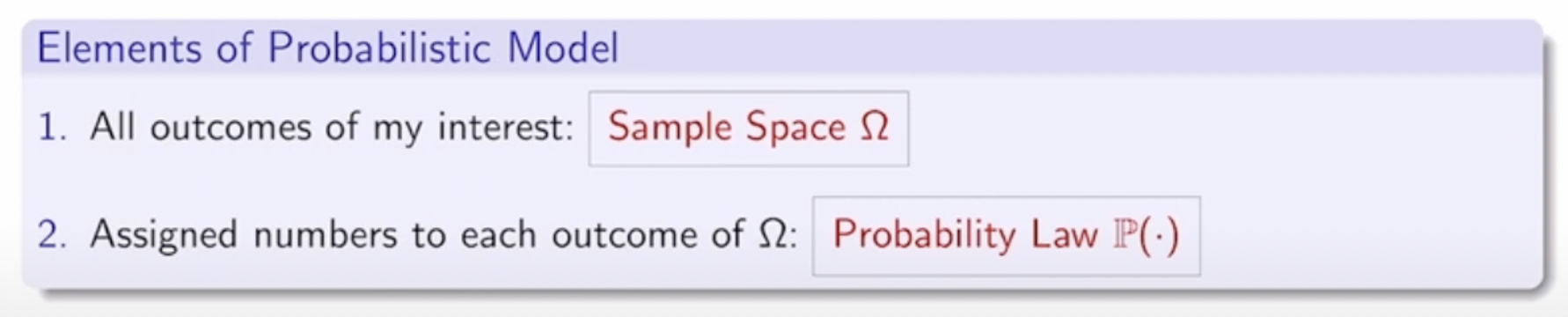
- 오늘은 probabilistic model을 위한 sample space와 probability law를 수학적으로 정립되도록 설정하는 방법을 정리해 보겠습니다.
Sample Space, Event, Probability Law
Elements of probability theory
-
Sample Space? → The set of all outcomes of MY INTEREST
-
Condition of Sample Space
1) Mutually exclusive → 어떤 사건이 발생하게 되면 다른 이벤트는 발생하지 않는다.
Sample Space Elements Mutually exclusive? Toss a Coin {H, T, HT} X Toss a Coin {H, T} O → 동전 던지기는 앞면 or 뒷면만이 존재할 수 있음 (Not H and T)
2) Collectively exhaustive → Sample space는 모든 상황을 커버할 수 있어야 함 → 발생할 수 없는 일이 sample space에 존재해서는 안 됨
Sample Space Elements Collectively exhaustive? Toss a Coin {H} X Toss a Coin {H, T} O → {H}는 T라는 발생할 수 있는 상황을 포함하고 있지 않음
3) At the RIGHT GRANULARITY, Not too concrete, not too abstract
-
내 interest가 동전의 앞, 뒷면 결과에 따른 날씨의 영향이라고 해보자.
Sample Space Right granularity? {H, T} X (too abstract) {(H, R), (T, R),
(H, NR), (T, NR)}
O→ R(Rain), NR(No Rain) → 마지막 sample space와 같이 내 interest에 부합하도록 ‘날씨’와 ‘동전’의 연관성(and)을 생각해서 sample space를 구성해야 함
-
-
Sample space의 종류
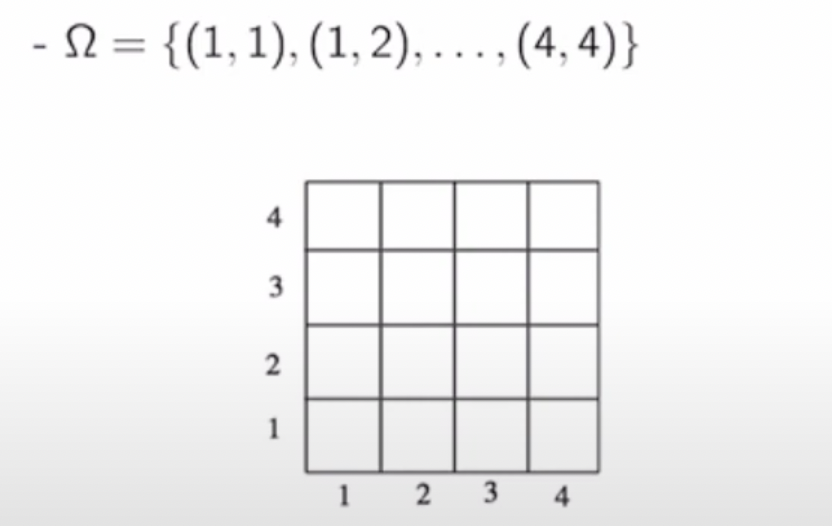
- Discrete case : Two rolls of a tetrahedral die
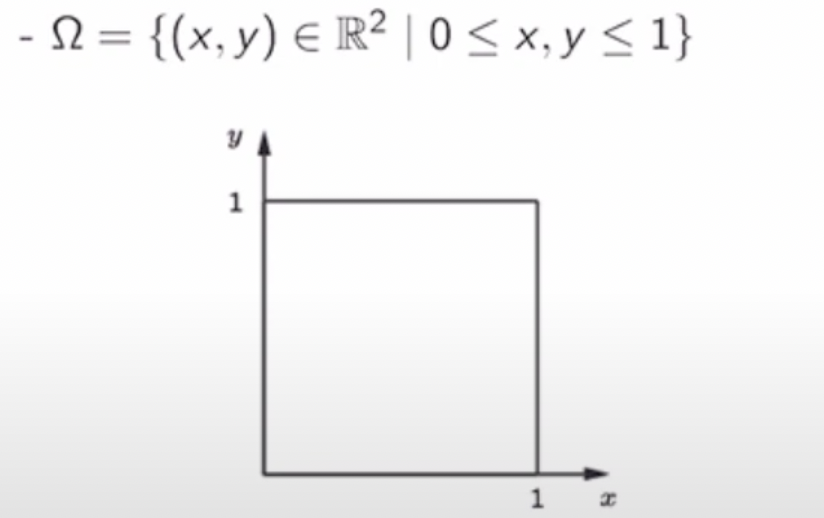
- Continuous case : Dropping a needle in a plain
- Discrete case : Two rolls of a tetrahedral die
-
Probability Law : Decide “Assign numbers to what?”
- Continuous case에서 정확히 좌표상 (0.5, 0.5)에 바늘을 떨어뜨릴 확률은? → 0이다. 좌표는 무수히 많기 때문. → 그렇다면, 이러한 경우엔 each outcome에 대한 number를 할당할 수 없음 → subset of Ω에 number를 할당 → subset of Ω == an event
- P(A) (Probability Law) = Probability of an event A → 주사위를 굴릴 때, 홀수일 확률은? → Ω = {1, 2, …, 6} → A = {1, 3, 5} (이벤트를 가정, 하지만 A ⊂ Ω을 만족해야 함)
-
Probability Axioms
3 axioms for the completeness of a theory
-
What is the starting points to construct P(-) that naturally satisfies the intention of a probability theory designer?
-
P(A) >= 0 for any event A ⊂ Ω (Nonnegativity)
-
P(A ∪ B) = P(A) + P(B) - P(A ∩ B)
-
P(A ∪ B) <= P(A) + P(B) → For two disjoint events A and B, P(A ∪ B) = P(A) + P(B) (Finite additivity)
→ 확장해보면, For any finite number of disjoint events,
A1, A2, …, An에 대해서, P(A1 ∪ A2 ∪ … ∪ An) = P(A1) + P(A2) + … + P(An)
→ Disjoint : P(A ∩ B) = 0
-
P(Ω) = 1 (Normalization)
-
P(Ø) = 0
-
many others…
-
-
꼭 그리고 이것만 지키면 된다! → No other things are necessary, and we can prove all other things from the above axioms.
-
Nonnegativity
-
Normalization
-
Finite additivity
-
-
Examples)
- For any event A, P(A) <= 1 을 기반으로 3 axioms를 발견
- 1 = P(Ω) = P (A U A^c) : Normalization
- P (A U A^c) = P(A) + P(A^c) : Finite additivity
- P(A) = 1 - P(A^c) <= 1 → P(A^c) >= 0 (A^c is also any event)
- For any event A, P(A) <= 1 을 기반으로 3 axioms를 발견
-
Probability Calculation Steps
- Specify the sample space
- Specify a probability law → from my earlier belief, from data, from expert’s opinion…
- Identify an event of interest
- Calculate
-
Examples)
-
Toss a coin (Biased)
- Ω = {H, T}
- P({H}) = 1/4, P({T}) = 3/4
- I want to know Probabilty of head or tail
- 1/4, 3/4
-
Discrete but infinite sample space
-
Ω = {1, 2, 3, …}, P({n}) = 1/(2^n), n = 1, 2, …
-
Is the above Probability law legitimate? → seems OK! → P(Ω) = 1/2 + 1/(2^2) + … = (1/2) / (1- 1/2) = 1
-
I want to know P(even numbers) !!! → P(even) = P({2, 4, 6, …}) = 1/(2^2) + 1/(2^4) + … = 1/3
-
Hmm… Is the above right? if not, why? → Wrong, FINITE ADDITIVITY axiom does not allow this. → 이해가 잘 가지 않는 부분…(08:04 ~ 10:42)
-
So, we have to change FINNITE to COUNTABLE
- Nonnegativity
- Normalization
- Countable additivity (finite ⊂ countable) → For any infinite number of disjoint events, A1, A2, A3, …에 대해서, P(A1 ∪ A2 ∪ A3 ∪ …) = P(A1) + P(A2) + P(A3) + …
** 그래서 이게 성립된다는거야 만다는거야….
-
-